Forestry Mulching vs. Bulldozing: Which Way to Clear Palmetto, Pine or Exotics on a Florida Lot?
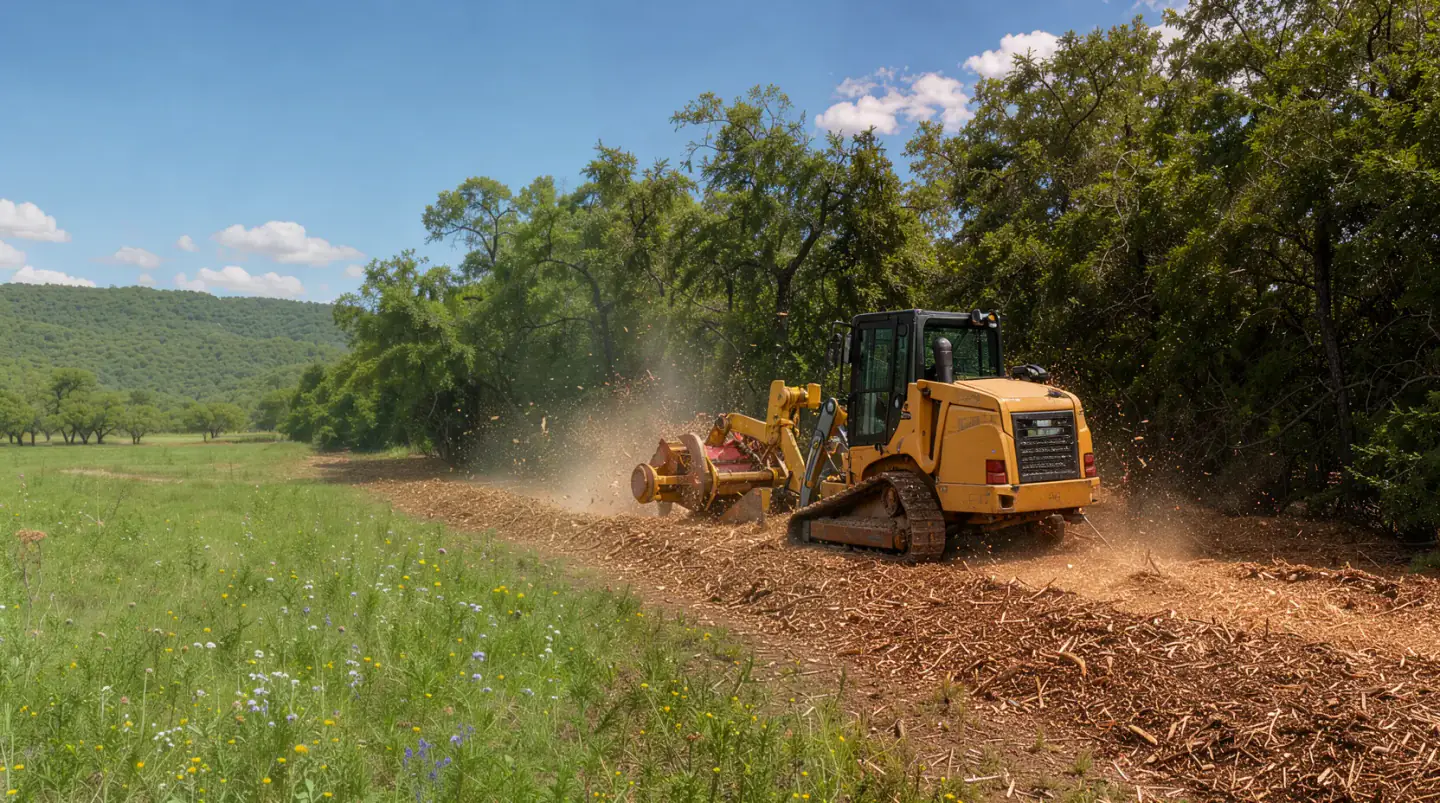
A forestry mulcher grinds the vegetation where it stands and leaves a mulch bed; a dozer will bulldoze it into piles that have to go somewhere. On a Florida lot the choice is settled by three things: what comes next on the dirt, how wet the ground is, and whether pepper or melaleuca is in the mix. I ran both on FPL corridors for ten years before I started Pellegrino Land Works in 2012. A mosquito in a cypress head has never missed a meal. Call (352) 619-3597 or send the form. Brandi texts you a scheduling window within the hour.
Get Your Free Estimate
Brandi texts you a window within the hour
How Forestry Mulching and Bulldozing Each Clear Land
Forestry mulching uses a single machine that does the labor of multiple ones: a skid steer or a dedicated carrier with a mulching head, a spinning drum fitted with steel teeth that shred vegetation in a single pass. It grinds brush and small trees, palmetto and 8-inch trees as well, into wood chips. The stumps stay, cut to 2 to 4 inches, so mulching leaves roots in the sand. Bulldozing is traditional land clearing: a Deere or Cat dozer with a root rake pushes trees, roots and the palmetto mat into brush piles, then a loader or an excavator to pull stumps and load trucks. It will strip the land bare down to the topsoil, which is what a slab needs and a lawn does not. One machine versus three, one step versus four. On the ROW we ran the mulcher to clear the corridor and the dozer only at the pole pads.
Cost Comparison: Mulcher Day Rate vs. Dozer by the Hour Plus Trucking
The skid steer forestry mulcher is $2,600 a day, transport included within 75 miles of Ocala or Punta Gorda, and will clear a half acre to an acre of palmetto a day. By the acre, mulching runs $1,500 to 2,500 on flatwoods and $1,200 to 1,800 on oak scrub. The dozer with root rake and operator is $170 an hour, and the debris then costs $700 to 1,300 per 10-yard load to haul. Flatwoods make three to five loads an acre, so land cleared to dirt by dozer lands at $3,000 to 5,500 an acre with the stumps out. Mulching is cheaper when the mulch can stay; bulldozing is cheaper only when you needed the stumps gone anyway. Call (352) 619-3597 or send the form with your acreage. Brandi texts you a scheduling window within the hour.
Speed: Acres per Day by Method and Density
Mulching is faster on anything under 8 inches, because nothing is handled twice. The skid steer will clear a half acre of thick palmetto or a full acre of light underbrush a day; the 300-hp machine does 2 to 4 acres. Our 5 acres in Golden Gate Estates took two skid steer days, $5,200, three tortoise burrows kept out. A dozer pushes an acre of flatwoods in a day too, but the piles then wait on trucks, and loading nine or ten loads is a second day. Larger trees flip the math: let a lot overgrow forty years and the slash pine over 12 inches goes faster pushed than ground. Count stems over 8 inches and send the number; that decides the machine and the days.
What Happens to the Debris: Layer of Mulch, Burn Piles or Trucks
Mulched, the debris is a 2 to 4 inch layer of mulch spread where the trees stood. The wood chips are organic material that retain moisture, hold the sugar sand in a June downpour, and suppress palmetto resprout for a season, enriching the soil as they rot, and the soil health improves every year the bed stays. Pushed, the debris is brush piles that leave by truck at $700 to 1,300 per load, or burn. Burning debris needs a Florida Forest Service Open Burning Authorization, issued daily, and platted urban lots are no-burn, so on most parcels the pile means trucking. The one-step process of mulching skips the cleanup entirely. After Ian we hauled 9 loads of storm damage off one acre in Punta Gorda, $8,100, because fallen trees over 12 inches do not mulch well.
Soil, Water and Roots: Sugar Sand, Flatwoods Hardpan, Muck and Caprock
Sugar sand on the ridges takes either machine any month. Flatwoods soil, spodosol with a hardpan 18 to 30 inches down, holds water an inch under the surface June to September; a mulching rig on tracks floats across it and a dozer sinks to the belly pan. Caprock in Collier and Lee, 20 to 40 inches down, eats drum teeth and stops a root rake cold. Soil disturbance is the other difference: unlike bulldozing, mulching leaves the root mat and the mulch bed, which prevents erosion on a slope with minimal environmental impact and keeps the swale clear; a dozed lot is bare sand with erosion risks until the sod goes down. The dozer wins the day you need the stumps out for a pad, because mulched stumps are still stumps. Tell me the county and the month and I tell you which machine the ground allows.
Melaleuca and Brazilian Pepper: Why Neither Method Works Alone
Both machines cut dense vegetation; neither kills the exotics in it. Pepper resprouts from any stump left alive, and melaleuca drops seed on disturbed sand, so a bare dozer pass plants the next thicket. The fix is cut-stump herbicide on the cambium within minutes of the cut, behind either machine, and that is the $500-an-acre surcharge. Our 2.5 acres of pepper thicket in Port Charlotte took two days and $6,700 including the surcharge. Northern pages talk about buckthorn, multiflora rose and briar; here the invasive plants and woody growth that return are pepper, melaleuca and grapevine. Collier's Vegetation Removal Permit requires the exotics gone, treated, not just cut. Count the red berries on your property lines before you compare bids.
When You Need a Dozer Anyway: Stumps, Pads, Fill, Driveways and Dead Groves
Five jobs where the dozer is not optional. A house pad: the stumps and root mat come out, the sand gets compacted, and the drum cannot do that. Fill: a low flatwoods lot takes 2 to 4 feet, pushed and shaped. A dead citrus grove: brittle trees with shallow roots push faster than they grind, as on our 20 acres in Lake Wales, four days with the 300-hp machine and dozer, $21,000 plus haul. Site prep for a building site after the drum has done the acres. The brush hog on the tractor, a rotary cutter, is the third tool for grass and saplings under 2 inches at $65 to 95 an acre. Chainsaw work fills the gaps; we fell the big pine by hand near a fence. Most lots use the mulcher for the acres and the dozer for the pad, and we price both on one sheet.
Which of the Land Clearing Methods Fits Your Lot
Five Florida lots, five answers.
- Palmetto lot for a house: mulcher for the lot, dozer for the pad and driveway, tree stumps raked only where the slab goes.
- Scrub acreage for pasture: drum only, mulch left as a bed, bush hog twice a year so the overgrowth never returns.
- Pepper thicket on a canal: drum plus cut-stump herbicide the same hour, no dozer, because bare sand reseeds melaleuca.
- Dead grove: dozer and big mulcher together, trees pushed, roots raked, debris trucked by the load.
- Ian debris: loader and trucks by the load, the drum for anything under 12 inches still standing.
Property owners who want firebreaks or trails through undergrowth and a sapling stand get the drum to clear a 12-foot strip; traditional clearing methods tear up more than the strip. Traditional methods still have their day. Send the form with your parcel ID and two photos, and Brandi texts you a window within the hour.
Land clearing across Florida
Six regions, two yards. Pick yours for local rates, permits and the towns we work.
More services and guides
Frequently Asked Questions: Forestry Mulching vs. Bulldozing
What does forestry mulching mean?
Forestry mulching means grinding standing trees, brush and palmetto into a mulch layer with a drum head on a skid steer or carrier, in one pass, with nothing hauled. The mulching services we run leave stumps at 2 to 4 inches and the mulch spread 2 to 4 inches deep where the trees stood.
Can a bulldozer knock down trees?
Yes, a dozer with a root rake pushes slash pine and oak over, roots and all, and that is how dead groves and pad sites get cleared. It strips the topsoil and leaves piles to haul, so on a lot that is not getting a slab it costs more than it saves.
What is the difference between a drum head and a disc head?
A drum head is a spinning drum with sharp teeth that grinds everything into fine chips and finishes the stump low; a disc head is a flat blade that fells and chops faster but leaves coarser debris and taller stumps. On Florida palmetto and pine we run drums on track or wheel carriers for the finish.
Does forestry mulching remove stumps and roots?
No. The head cuts the stump to 2 to 4 inches and the roots stay. Pine and oak stumps rot in two to five years; pepper and melaleuca stumps get herbicide or they resprout. For a pad, we grind stumps at $4.50 an inch or rake them out with the dozer at $170 an hour.
How much does forestry mulching cost in Florida?
$2,600 a day for the skid steer rig, transport included within 75 miles of Ocala or Punta Gorda, or $1,500 to 2,500 an acre on palmetto flatwoods. Pipeline and power line corridors taught me to price by the ground, so call (352) 619-3597 with your parcel ID and the estimate is free inside 75 miles.
Ready to Clear Your Lot?
Send the form or call. Brandi texts you a scheduling window within the hour.