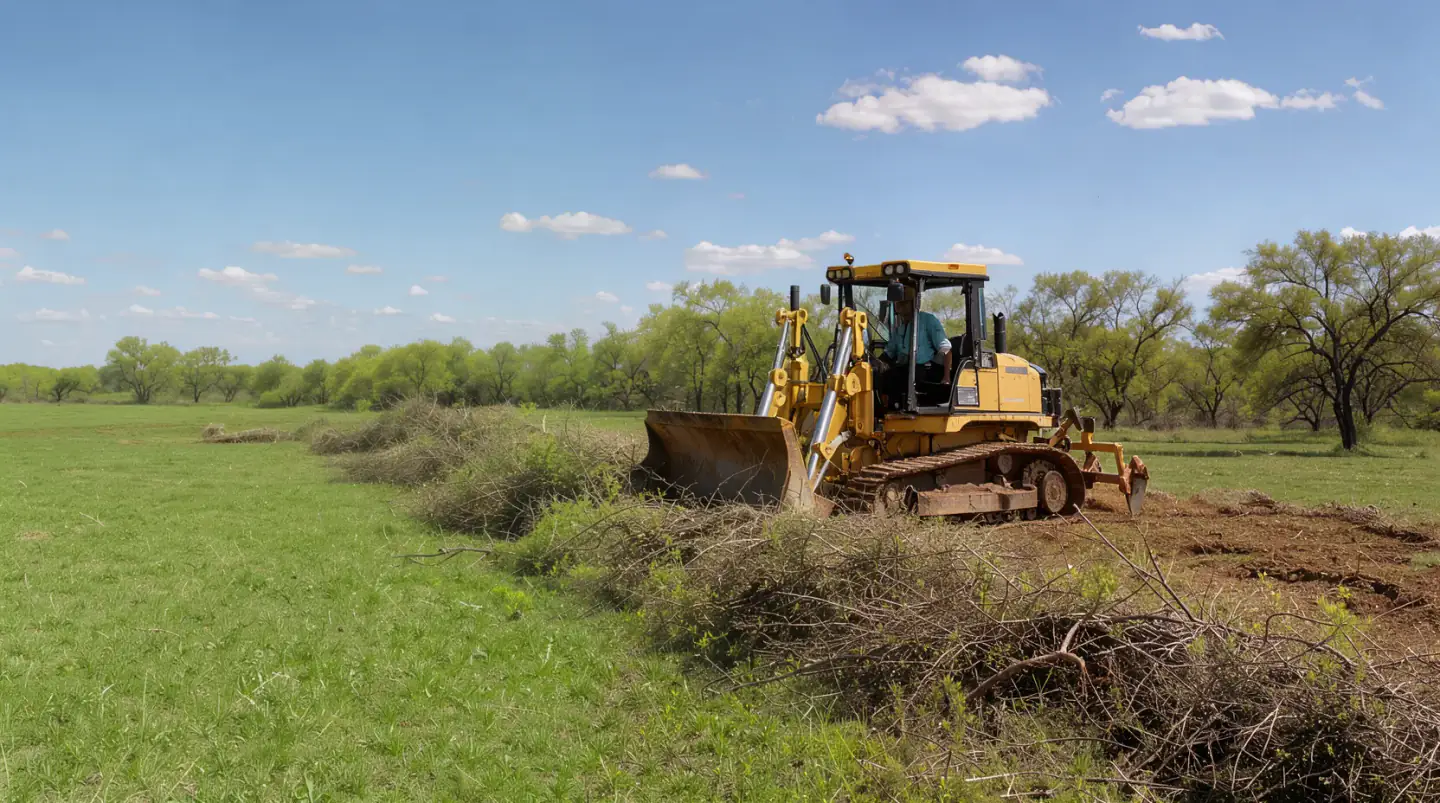
What Is Land Clearing? Methods, Equipment, Permits and What to Expect on a Florida Lot
Land clearing is the process of removing trees, palmetto, shrub and other vegetation from a piece of land so you can use the land for something else: a house pad, a pasture, a driveway, a firebreak. Land clearing is essential before you build a new house on a wooded lot, and it turns an overgrown parcel into a usable one for whatever land use you have in mind. In Florida that means palmetto root mats, slash pine, Brazilian pepper and ground that is sand or soup depending on the month. I learned land clearing where the corridor ended and the muck began. Call (352) 619-3597 or send the form. Brandi texts you a scheduling window within the hour.
Get Your Free Estimate
Brandi texts you a window within the hour
What Land Clearing Means and What a Land Clearing Project Includes
Land clearing means taking a wooded or overgrown parcel down to a condition you can build on, mow or plant. A land clearing project on a Florida lot includes five tasks: cutting or mulching trees and brush, grubbing stumps and roots where the slab goes, hauling or spreading the debris, rough grading, and treating the exotics. Brush and tree removal is step one, and it is where tree removal services stop. A tree service will cut down trees one at a time; a land clearing company will clear the land by the acre. We do not do fill, septic, wells or concrete; I know people who do. Clearing a plot of land is priced by the size of the area to be cleared and, depending on the location, by transport from Ocala or Punta Gorda. Residential land clearing is a quarter acre to five acres; extensive land for a subdivision or grove runs to hundreds. Our 1.25-acre Palm Coast job is the typical size: scrub oak and palmetto, one day, $2,600. Know which of the five tasks you need before you call anyone.
Land Clearing Methods: Mulching, Grubbing, Pushing, Hand Clearing and Burning
Five methods, and the ground picks. A rotary cutter handles light brush; thick brush and palmetto go to the mulcher. Forestry mulching grinds trees and other vegetation into a mulch layer where they stand, stumps cut to 2 to 4 inches, nothing hauled; it is effective for removing certain types of vegetation that resprout, because the mulch layer slows the palmetto. Grubbing is a dozer with a root rake pulling stumps and the palmetto root mat out of the sand for a pad, $170 an hour. Pushing is the dozer alone, trees piled for haul-off, as on our 20-acre Lake Wales grove, $21,000 plus haul. Hand clearing is chainsaws and manual labor inside a 25-foot tortoise buffer. Burning requires careful timing and a Florida Forest Service Open Burning Authorization, issued daily on the risk of the fire spreading, and platted urban areas are no-burn, so the pile leaves by truck or stays as mulch. Choosing the right method of land clearing comes down to what goes on the dirt next: a lawn wants mulch, a slab wants bare sand.
Equipment Used in the Land Clearing Process: Mulchers, Skid Steers, Dozers, Excavators
The land clearing process in Florida runs on four pieces of heavy machinery. Forestry mulchers: a skid steer with a drum head, $2,600 a day, stems to 8 inches, and a dedicated 300-hp unit, $4,000 a day plus transport, for 12-inch pine. A bulldozer with a root rake for grubbing and pads. An excavator for stumps and loading trucks. A tractor with a rotary cutter, the bush hog, for grass and stems under 2 inches at $65 to 95 an acre. Mats go under all of it on muck, and grubbing the driveway first gives access for construction vehicles. On the ROW we ran mulchers on tracks across wet flatwoods because they float where bulldozers and excavators sink. Specialized equipment matched to the ground is what effective land clearing means. Ask which machine is coming before you compare bids.
Residential, Commercial and Agricultural Land Clearing Services in Florida
Three kinds of customers, three approval paths. Residential land clearing services cover platted lots and small acreage; the county wants vegetation or land-clearing permits tied to your building approval. Commercial clearing for land development, a store pad or a subdivision, runs through a site plan and usually an ERP at the water management district for the stormwater pond. Agricultural clearing is the exception: land for farming, pasture or timber under FS 193.461 greenbelt classification and the FS 823.14 Right to Farm Act is exempt from most county clearing permits, and silviculture BMPs under FS 403.927 cover a timber harvest. Clearing land for agriculture still answers to the gopher tortoise rule and the eagle buffer. Professional land clearing there follows proper land management techniques: leave the live oaks, mulch the understory, keep the wiregrass. When is land clearing necessary on greenbelt ground? When you let a pasture overgrow past what the bush hog can cut. Our 10 acres in Crawfordville, cleared for agricultural purposes and a homesite, took two days, $9,500 plus transport. Residential and commercial lots pay the same day rate.
Do You Need a Permit to Clear Land in Florida?
On a platted lot, almost always yes; on greenbelt acreage, usually no. Lee, Collier, Charlotte, Sarasota, Hillsborough, Orange, Brevard, Palm Beach and most other counties require vegetation removal or land-clearing permits before you cut, and Palm Coast and Palm Beach County issue none until the house plans are approved. Certain types of parcels skip the county step: greenbelt acreage and timber under BMPs. The FDEP Environmental Resource Permit, run by the five water management districts, is not triggered by cutting; it is triggered by filling a wetland or changing drainage. USACE Jacksonville District handles federal wetlands under Section 404 again since the state program was vacated in 2024. FWC requires a gopher tortoise survey within 90 days of clearing, $400 to 900, and a relocation permit before any machine runs within 25 feet of a burrow. Call (352) 619-3597 with your parcel ID and I tell you which permits apply.
What Counts as a Wetland on Your Lot and Who Decides
A cypress head, a bay swamp, a wet prairie or hydric flatwoods with standing water June to October is a wetland until a delineation says otherwise. Florida uses the Chapter 62-340 method: hydric soil, wetland plants, and signs of water, any two of three. You can mulch inside the line with no fill and no ERP in most districts; the ERP starts when you fill it. The line is there to protect the environment downstream and the habitat for wildlife in the strand. The environmental impact of filling a cypress head is a flooded neighbor, which is why the rule is important in areas like Golden Gate Estates, where the ecosystem holds the water table, one of the resources for future generations the districts guard. I walked a lot in Lehigh Acres last fall where the owner wanted the whole acre filled; the delineation cut it to 0.6 and saved him a mitigation bill. Order the delineation before you order the fill.
Does Clearing Land Add Value to a Florida Lot?
A dry, mulched, surveyed lot sells faster and for more than the same acre behind a pepper wall. Our 5 acres in Golden Gate Estates went from palmetto under slash pine to a walkable, buildable parcel in two days, $5,200, with three burrows kept out. Selective clearing, or targeted clearing around the live oaks and cabbage palms you keep, adds more than scraping the lot bare, because the shade is worth money in August. Clearing makes room for new construction; remove trees only where the pad and driveway go, and clearing away the exotics removes a code-enforcement risk in Collier and Lee. Land clearing can also cost you value if the mulch bed is scraped off. Clear for the buyer you want, not for the cheapest bid.
What Happens After Clearing: Fill, Grading, Seeding, Regrowth Control and Building
After the mulcher leaves, five things happen in order. Fill, if the pad sits low; flatwoods lots in Lee and Collier take 2 to 4 feet to get the slab above the road. Grading, to send water to the swale and not the neighbor. Seeding or sod on the disturbed sand, because bare sugar sand moves in a June downpour and soil erosion on a slope costs more than seed. Regrowth control: palmetto resprouts from the rhizome in a season, pepper and melaleuca from any untreated stump, and bahiagrass overgrows a pad in a summer, so plan a bush hog pass twice a year on open land and herbicide on the exotics. Clearing the land and preparing it for a slab are two trades; preparing land ends when the builder's site preparation and land preparation crews take over. Silt fence and other erosion control measures are the builder's call.
Need to Clear Land in Florida? Get a Free Estimate
A free on-site estimate within 75 miles of Ocala or Punta Gorda, in writing, with acres, method, days and dollars. Call (352) 619-3597 or send the form with your parcel ID. Brandi texts you a scheduling window within the hour. I've cleared this ground since 2012, from a quarter-acre infill to a 20-acre grove, and the number you get is the number on the invoice.
Land clearing across Florida
Six regions, two yards. Pick yours for local rates, permits and the towns we work.
More services and guides
Get Your Free Estimate
Send the form or call. Brandi texts you a scheduling window within the hour.